
Updates on Middle Eastern Ports Amid Geopolitical Conflict; Maersk Halts Gulf Transits
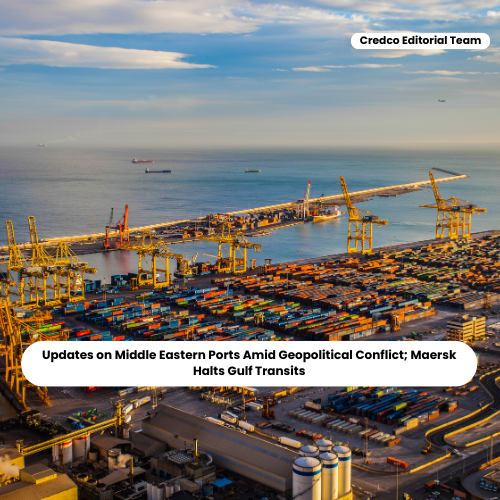
UAE Ports Resume After Brief Disruption
In the United Arab Emirates, major ports have largely maintained operations despite security concerns. Jebel Ali Port, the region’s largest container hub, briefly suspended activities after debris from aerial interceptions caused a fire at one berth. Following safety inspections, operations across all four terminals resumed, with enhanced precautionary measures now in place.
Other UAE ports — including Fujairah, Khor Fakkan, and Sharjah — continue to function normally, handling cargo and bunkering operations without formal suspension.
Oman, Bahrain and Qatar Maintain Services
In Oman, ports such as Duqm remain operational despite reports of drone activity in nearby waters. One worker was reportedly injured in a related incident outside port premises, but authorities have kept port services active while advising heightened caution.
Bahrain temporarily suspended certain port movements, including pilotage services, as a precautionary response to aerial threats, although detailed advisories have been limited.
In Qatar, key facilities including Ras Laffan and Mesaieed continue to operate. However, GPS signal disruptions have prompted navigational warnings and increased vigilance among shipping operators.
Other Gulf States Continue Normal Operations
Ports in Iraq, Kuwait, and Saudi Arabia are functioning without major operational halts. Despite broader transit disruptions and warnings related to the Strait of Hormuz — a critical passage for roughly 20% of global oil trade and significant LNG volumes — port terminals in these countries continue cargo handling and vessel services under standard safety protocols.
Shipping data indicates that numerous tankers and cargo vessels have anchored in Gulf waters, reflecting caution among operators amid regional security uncertainties.
Global Shipping Adjustments Intensify
The escalating conflict has prompted several global carriers to reassess routing decisions. Some vessels are avoiding high-risk areas, including the Strait of Hormuz and, in certain cases, the Bab el-Mandeb Strait and the Suez Canal. Alternative routes around the Cape of Good Hope are being used, resulting in longer transit times and higher operating costs.
These adjustments, combined with temporary port suspensions and security restrictions, are increasing pressure on global freight markets. Industry participants are closely monitoring the situation, as prolonged disruption could affect freight rates, insurance premiums, and supply chain stability.
Maersk Suspends Key Gulf and Suez Transits
Maersk has announced precautionary operational changes across the Gulf region. The company has suspended all vessel transits through the Strait of Hormuz and paused future Trans-Suez sailings via the Bab el-Mandeb Strait and the Suez Canal, citing deteriorating security conditions.
As part of its contingency measures, Maersk is rerouting key services — including ME11 (Middle East–India to Mediterranean) and MECL (Middle East–India to US East Coast) — around the Cape of Good Hope. These diversions significantly extend voyage durations compared to traditional routes.
The carrier also indicated potential operational disruptions in the UAE, Oman, and Qatar. Warehousing facilities in the UAE have been temporarily closed, and office operations are being limited in accordance with local government safety guidance. Maersk stated that it continues to accept cargo for the region where feasible and will provide updates as the situation develops.
Stay ahead of market trends with the Credco app. For any queries, please reach out to us via WhatsApp at +918448083211.
Related on the Wire
- Supply·Thursday, 15 October 2026
Middle Eastern Producer Issues New PP Film Offers to India Amid Tightening Supply
A Middle Eastern producer has recently announced new offers for polypropylene (PP) film to the Indian market. This move highlights the competitive nature of import supplies in the region. However, specific details such as volumes, netback, and buyer responses remain undisclose…
Read story - Crude·Thursday, 22 October 2026
India’s Middle East Crude Imports Rebound 32% in September
India’s crude oil imports from the Middle East recovered to levels last seen before the war in September, supported by increased oil shipments through the Strait of Hormuz. Meanwhile, India’s purchases of Russian crude declined as Chinese buyers increased competition for Russi…
Read story - Polymer·Tuesday, 13 October 2026
Polyethylene (PE) Prices Steady in GCC Amid Cautious Buying
Polyethylene (PE) prices in the Gulf Cooperation Council (GCC) region have remained steady, influenced by cautious buying behavior and weak downstream demand. The stability in prices covers various types of polyethylene including high-density polyethylene (HDPE), low-density p…
Read story - Supply·Tuesday, 13 October 2026
Polypropylene Prices Surge in GCC Amid Limited Supply and Rising Freight Costs
Polypropylene (PP) prices in the Gulf Cooperation Council (GCC) region have experienced a significant surge. The increase is attributed to limited availability of the material and elevated freight costs, as reported by Polymerupdate. The geopolitical tensions, particularly the…
Read story