
Three crude tankers and two LNG carriers successfully transit Strait of Hormuz amid ongoing disruption
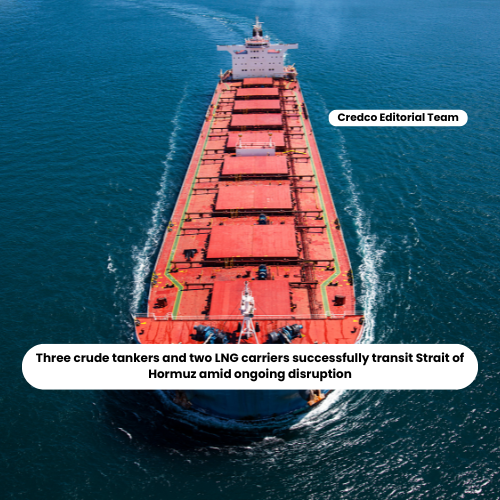
One of the crude carriers is transporting nearly 2 million barrels of Saudi crude oil to China, while another tanker carrying around 1.8 million barrels of UAE-origin crude is reportedly bound for India for delivery to Hindustan Petroleum. In addition, LNG carrier Umm Al Ashtan was also reported to have crossed the Strait earlier this week.
Market sources indicated that several of the vessels transited the area with tracking systems switched off as a precautionary measure amid ongoing regional tensions and security risks around the waterway.
Although tanker movement through the Strait of Hormuz has shown slight improvement in recent weeks, shipping activity remains heavily restricted overall. Since early March, hundreds of vessels, including crude oil and gas carriers, have remained stranded in the Persian Gulf due to the effective disruption of traffic through the strategic route.
The Strait of Hormuz remains one of the world’s most critical energy chokepoints, handling nearly one-fifth of global oil and gas flows. Continued disruption in Middle Eastern exports has significantly reshaped global energy trade patterns in recent months.
The supply disruptions have also increased demand for US energy exports, particularly toward Europe. Market participants noted that some Asian buyers have additionally started sourcing crude cargoes from alternative regions to manage supply shortages.
In a notable development, the Philippines recently imported a rare crude cargo from the United States after years without US crude purchases. Before the current regional conflict, many Asian countries relied heavily on Middle Eastern suppliers for the majority of their crude oil requirements, with some nations sourcing up to 80% of imports from the region.
Industry estimates suggest that since the escalation of military tensions involving Iran, disruptions to global oil production and exports have affected between 14 million and 15 million barrels per day, keeping global energy markets under severe pressure.
Stay ahead of market trends with the Credco app. For any queries, please reach out via WhatsApp at +91 8448083211.
Related on the Wire
- Crude·Thursday, 22 October 2026
India’s Middle East Crude Imports Rebound 32% in September
India’s crude oil imports from the Middle East recovered to levels last seen before the war in September, supported by increased oil shipments through the Strait of Hormuz. Meanwhile, India’s purchases of Russian crude declined as Chinese buyers increased competition for Russi…
Read story - Crude·Monday, 28 September 2026
Saudi Yanbu Crude Loadings Remain Stalled Despite Pipeline Restart
Crude oil flow through Saudi Arabia's pipeline to refineries on the Red Sea coast has resumed, yet crude loadings at Yanbu remain stalled. This disruption is significant for feedstock logistics, potentially constraining or delaying regional polymer supply, particularly affecti…
Read story - Crude·Tuesday, 22 September 2026
China PE Market Shows Mixed Trend as Crude Prices Weaken
China’s polyethylene (PE) market has opened the week on a mixed note, with domestic prices seeing some downward revisions while most import offers remain stable or slightly higher. However, selected Middle Eastern grades, particularly HDPE and LLDPE, have faced small price red…
Read story - Crude·Tuesday, 22 September 2026
Brent Slips Below $100 as Iran Hormuz Reopening Reports Ease Supply Concerns
Oil prices continued to move lower on Tuesday, with Brent crude dropping below the $100/bbl level as reports that Iran could reopen the Strait of Hormuz within seven days reduced concerns over prolonged disruptions along the key global oil shipping route. Iran has reportedly i…
Read story