
Hormuz Restrictions Continue to Support Oil Prices Despite Ceasefire
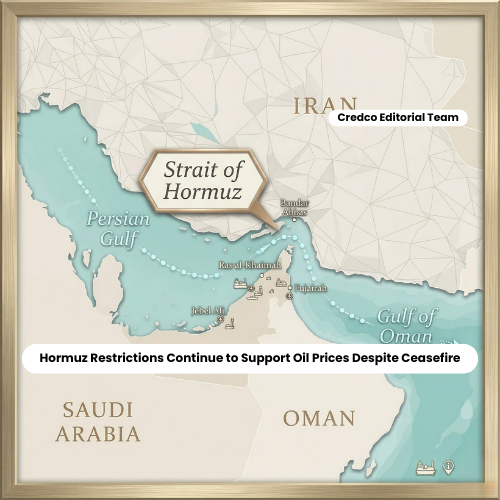
The vital oil and LNG transit route is still operating under tight control, with vessel movement being selectively managed rather than freely flowing through standard commercial channels. Shipping activity remains limited, and there has been no significant increase in traffic since the ceasefire was announced, indicating that supply disruptions are still very much in place.
Market analysts emphasize that the ceasefire has not resolved the core issue of restricted energy flows. The Strait continues to function under controlled conditions, preventing a full return of oil and gas shipments to global markets. As a result, the broader supply shock that developed over recent weeks is yet to ease.
Shipping companies and traders are proceeding with caution, as uncertainty around safety conditions and transit permissions persists. Some market participants have started exploring shipments to the region, but overall sentiment remains guarded. Even in the best-case scenario of a full reopening, experts suggest that normalizing supply chains could take several months due to logistical and operational delays.
The continued constraints are keeping the oil market tight, particularly for immediate deliveries. Forecasts suggest that if the situation does not improve, crude prices could remain elevated, with the possibility of sustaining levels above $100 per barrel. In more severe scenarios involving prolonged disruption, prices could climb even higher, adding further pressure on global economies.
Economists warn that sustained high oil prices could slow economic growth worldwide, with potential recession risks in major regions if the situation escalates further. The longer the disruption continues, the greater the impact on energy-dependent industries and overall economic stability.
In summary, although the ceasefire has reduced the risk of further escalation in the short term, it has not addressed the underlying supply bottlenecks. Until the Strait of Hormuz fully reopens and normal shipping resumes, oil markets are likely to remain under upward pressure with continued volatility.
Stay ahead of market trends with the Credco app. For any queries, please reach out via WhatsApp at +91 8448083211.
Related on the Wire
- Crude·Monday, 28 September 2026
Saudi Yanbu Crude Loadings Remain Stalled Despite Pipeline Restart
Crude oil flow through Saudi Arabia's pipeline to refineries on the Red Sea coast has resumed, yet crude loadings at Yanbu remain stalled. This disruption is significant for feedstock logistics, potentially constraining or delaying regional polymer supply, particularly affecti…
Read story - Crude·Tuesday, 22 September 2026
Brent Slips Below $100 as Iran Hormuz Reopening Reports Ease Supply Concerns
Oil prices continued to move lower on Tuesday, with Brent crude dropping below the $100/bbl level as reports that Iran could reopen the Strait of Hormuz within seven days reduced concerns over prolonged disruptions along the key global oil shipping route. Iran has reportedly i…
Read story - Crude·Wednesday, 9 September 2026
China PP Rally Strengthens as Rising Oil and Tight Supply Support Prices
China’s polypropylene (PP) market has maintained its upward trend since early August, with the pace of gains accelerating over the past two weeks. Market participants reported sharper increases this week across domestic, import and export segments. Import offers rose by up to …
Read story - Crude·Tuesday, 8 September 2026
Brent Approaches $100 as US-Iran Tensions Reignite Hormuz Supply Concerns
Oil prices continued their upward move on Tuesday, with Brent nearing the $100/bbl mark as renewed US-Iran hostilities brought fresh concerns over potential disruptions through the Strait of Hormuz. Stronger Chinese crude purchases also supported the market, while traders awai…
Read story