
Canada-China Trade Framework May Reshape Regional Growth Outlook
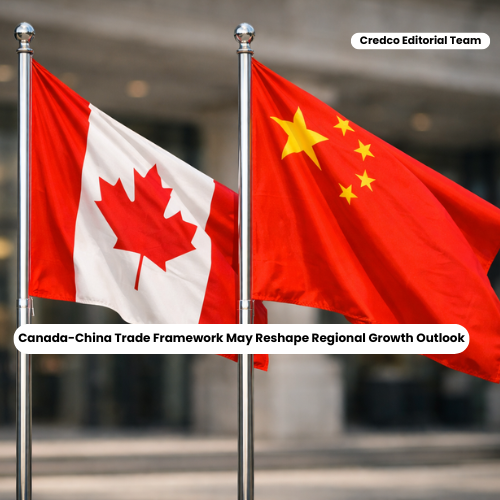
Under the framework announced in January, Canada agreed to reduce tariffs on an initial annual quota of 49,000 Chinese electric vehicles (EVs). In return, Beijing committed to lowering retaliatory duties on Canadian canola and certain other agricultural exports. Canadian officials described the deal as the beginning of a new strategic partnership aimed at fostering investment and strengthening Canada’s EV supply chain.
Economists suggest that while the overall macroeconomic impact is likely to be limited in the near term, sectoral and regional implications could be more pronounced. Western provinces, particularly those with significant agricultural exports to China, are expected to benefit from improved market access.
Conversely, increased imports of Chinese EVs may intensify competitive pressures on Canada’s automotive sector, which is largely concentrated in Ontario. Although Canada does not yet manufacture EVs at scale, analysts warn that sustained inflows of Chinese vehicles could influence the long-term development of a domestic EV manufacturing ecosystem.
Despite the renewed engagement with China, the United States remains Canada’s largest trading partner by a wide margin. As a result, the country’s broader economic outlook will continue to depend heavily on developments related to the review and renewal of the US-Mexico-Canada Agreement (USMCA). Ongoing trade policy uncertainty surrounding North American negotiations is expected to remain a key factor shaping business investment and growth prospects in the years ahead.
Stay ahead of market trends with the Credco app. For any queries, please reach out to us via WhatsApp at +918448083211.
Related on the Wire
- Polymer·Wednesday, 16 September 2026
India’s Domestic Polymer Prices Gain Further Support as Import Costs Rise
India’s domestic polymer market has entered another phase of price increases, with major producers raising prices across PP, PE and PVC as higher international resin values, energy costs and freight rates lift import replacement costs. The recent revisions are giving domestic …
Read story - Polymer·Wednesday, 7 October 2026
Southeast Asia PP, PE Markets Stay Flat as China Holiday Slows Trade
Southeast Asia’s PP and PE markets remained largely stable at the start of the week, with traders and converters reporting little change in both domestic and import prices. China’s ongoing National Day holiday has reduced the availability of fresh import offers, leaving local …
Read story - Supply·Friday, 16 October 2026
Turkey’s PVC Market Loses Momentum as Weak Demand Limits October Price Increases
Turkey’s imported polyvinyl chloride (PVC) market has begun to lose strength following several price increases in September and early October. Persistently weak demand from downstream industries and limited liquidity are increasingly challenging sellers’ firm pricing strategie…
Read story - Supply·Friday, 9 October 2026
European PVC Producers Push for October Increases as Buyers Resist Higher Offers
European PVC producers are entering October with plans to raise prices after the softer market conditions seen in September. Higher feedstock and energy costs are driving sellers to seek better margins, but sluggish consumption and sufficient material availability are limiting…
Read story